

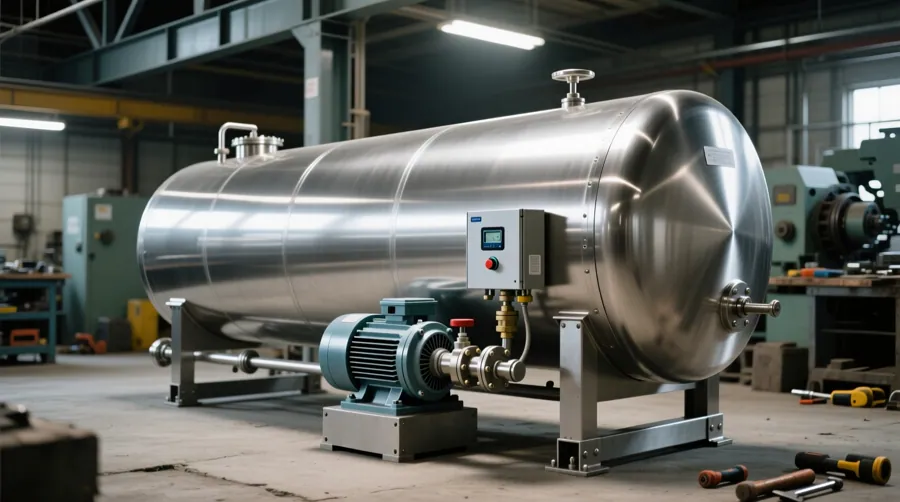
A water heating system is the equipment that raises water to the temperature a process, a building or a facility needs, and then holds it there reliably through the working day. Herambh Coolingz designs and manufactures water heating systems for industrial, commercial and hospitality duty from its works in Aurangabad, Maharashtra.
Our water heating range is built around robust heat generation, safe controls and simple service access, so that plant engineers can keep hot water available without constant supervision. Every system is engineered to the client's process temperature, flow and site conditions rather than supplied as a fixed catalogue box.
What a Water Heating System Does
At its simplest, a water heating system takes cold feed water, adds heat through a primary source such as an electric immersion element, a heat pump circuit or a fuel-fired heat exchanger, and delivers the warmed water to storage or directly to the point of use. The selection of heating method depends on the temperature required, the volume drawn per hour and the energy source available on site.
A well-matched system also protects itself. Thermostats, high-limit cut-outs and low-water protection keep the heater from running dry or overheating, while insulation keeps standing losses low so the stored water stays hot between draws.
Where Industrial Water Heating Is Used
Manufacturing plants use heated water for pre-treatment baths, surface cleaning, degreasing and process rinses. Chemical and pharmaceutical units need closely controlled hot water for reaction and dilution steps. Food and dairy lines depend on hot water for washing, sterilising and clean-in-place routines.
Commercial buildings, hotels, hospitals and hostels draw domestic hot water for kitchens, laundries and bathrooms. In each case the duty is different, so the heater is sized on peak draw rather than on average use, and recovery capacity is matched to the demand profile of the site.
Types of Water Heating System
Storage-type heaters keep a tank of hot water ready for immediate use and suit sites with short, frequent draws. Instantaneous or flow-through heaters raise water temperature as it passes, which suits continuous process demand where stored volume is impractical. Heat pump based water heaters recover heat from ambient air and use notably less electricity per litre heated.
For higher temperatures, thermic fluid and steam-based heat exchangers are used to transfer heat into water without direct firing. The correct type follows from the required outlet temperature, the daily consumption and the utilities already available in the plant.
Construction and Materials
Tanks and shells are fabricated in mild steel or stainless steel depending on the water quality and hygiene requirement, with internal surfaces prepared for the duty. Heating elements or tube bundles are selected for the water chemistry to limit scaling. External surfaces receive a protective finish suited to the plant environment.
Piping, valves and instrumentation are arranged so that isolating any single component for maintenance does not shut down the whole system. Insulation is applied to tanks and hot lines to reduce heat loss and improve overall efficiency.
Controls, Safety and Efficiency
Digital temperature controllers hold the set point within a narrow band, and timers allow the system to pre-heat before a shift begins rather than run at full output around the clock. Optional level and flow interlocks stop the heating source when water is not moving.
Efficiency comes from three things: insulating the stored volume, matching heating capacity to real demand, and recovering heat where the process allows. Heat pumps and heat recovery from compressors or exhaust streams can cut the energy needed to reach the same temperature.
Selection and Customisation
Right selection starts with four questions: what outlet temperature is needed, how many litres are drawn in the busiest hour, what utilities are available, and how much floor or roof space can be given to the plant. From those answers the heating capacity, storage volume and control scheme follow.
Herambh Coolingz offers customisation of the shell, the heating source and the instrumentation so the water heating system fits the line it serves. Because we manufacture in-house, changes in duty or layout can be accommodated without redesigning the whole installation.
Installation and Service
The system is supplied with a clear piping and wiring scheme so that site installation follows a known layout. Commissioning includes checking set points, verifying safety interlocks and confirming that recovery times match the design brief.
Routine attention is limited to cleaning heating surfaces, checking controls and inspecting insulation and fittings. Easy access to the element or tube bundle and to the control panel keeps this work quick and does not require dismantling the surrounding piping.
- Storage and instantaneous designs
- Heat pump based hot water generation
- Thermic fluid and steam heat transfer
- Insulated tanks and hot water lines
- Digital temperature control with safety interlocks
| Parameter | Details |
|---|---|
| Heating medium | Water, with electric, heat-pump or heat-transfer source |
| Tank / shell material | Mild steel or stainless steel, to suit water quality |
| Temperature control | Digital controller with high-limit cut-out |
| Safety features | Low-water and over-temperature protection |
| Insulation | Applied to tank and hot lines to cut standing loss |
| Customisation | Capacity, source and controls built to site duty |
For a water heating system matched to your process temperature and peak draw, share your duty details with the Herambh Coolingz team and we will propose the right arrangement for your site.