

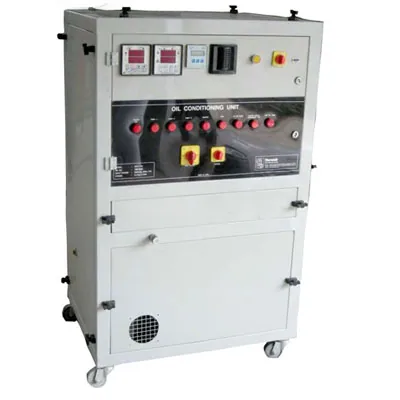
An oil conditioning unit keeps hydraulic and lubricating oil in the condition the machine needs: at the right temperature, free of contamination and with the right viscosity. Herambh Coolingz builds oil conditioning units for industrial plants from its works in Aurangabad, Maharashtra.
Oil degrades in service through heat, moisture and particles, and each of those harms a hydraulic or lubrication system in its own way. A conditioning unit addresses them together, cooling the oil, filtering it and keeping the circuit stable so the machine performs as designed.
What an Oil Conditioning Unit Does
The unit circulates oil from a reservoir or system through a cooling section and a filtration section, then returns it clean and at the correct temperature. Depending on the duty it may also remove water, maintain pressure and provide the instrumentation needed to monitor oil condition.
Because it works continuously, a conditioning unit keeps oil inside its design window rather than letting it drift until a problem shows up as wear or a stoppage.
Why Oil Condition Matters
Hot oil thins and loses the film that separates moving surfaces, so wear accelerates. Water in oil promotes corrosion and reduces lubricity. Particles abrade clearances, jam valves and act as catalysts for further breakdown. Together they shorten both oil life and machine life.
Keeping temperature, cleanliness and moisture under control is far cheaper than replacing damaged components or oil that has been allowed to degrade.
Cooling the Oil
The cooling section transfers heat from the oil to water or air across a heat exchanger, with a thermostatic arrangement to bypass cooling when the oil is already cool enough. That prevents over-cooling, which raises viscosity and pumping losses.
Cooler selection is based on the heat the system generates and the allowable oil temperature, with the pressure drop across the unit kept within what the circuit can accept.
Filtration and Contamination Control
Filtration removes particles that would otherwise circulate and abrade. Filters are selected for the cleanliness level the components require, with pressure indicators that signal when a filter needs changing rather than leaving it to chance.
Where water ingress is possible, separation arrangements remove free water before it damages bearings or promotes corrosion, and breathers keep moist air out of the reservoir.
Typical Applications
Hydraulic power packs on presses, injection moulding machines and machine tools generate heat and particles as they work. Turbine and gearbox lubrication systems require steady oil temperature and cleanliness. Heat treatment quench systems and test rigs also rely on conditioned oil.
In each duty the unit is arranged to suit the reservoir, the pump and the temperatures involved, so it integrates with the machine rather than competing with it.
Construction and Components
A conditioning unit brings together a pump, a heat exchanger, filtration elements, valves, instrumentation and a control panel. Materials are chosen for the oil and the coolant in use, and the layout keeps the filter and cooler accessible for routine service.
Joints are arranged so that oil and coolant cannot mix even under pressure variation, which protects both the system and the conditioning unit itself.
Selection and Sizing
Selection depends on the oil flow, the heat to be removed, the required cleanliness and dryness, the oil type and the allowable pressure drop. Those answers fix the pump, the cooler and the filtration stage needed for the duty.
Herambh Coolingz builds conditioning units to the system they serve rather than to a single fixed specification, so the unit supports the machine it is attached to.
Maintenance and Reliability
Routine work covers changing filter elements on indication or schedule, cleaning heat transfer surfaces, checking the pump and controls and monitoring oil condition over time. Clean coolers and fresh filters preserve both capacity and oil life.
Recording oil temperature and filter pressure drop in normal operation makes degradation visible early, which turns maintenance into a planned task instead of a reaction to failure.
- Holds oil temperature within its working band
- Filtration to the required cleanliness level
- Water removal where ingress is possible
- Thermostatic bypass to avoid over-cooling
- Monitoring to show filter and oil condition
| Parameter | Details |
|---|---|
| Functions | Cooling, filtration and moisture control of oil |
| Cooling medium | Water or air, as the site allows |
| Filtration | Elements selected for required cleanliness |
| Control | Thermostatic bypass to hold oil temperature |
| Instrumentation | Temperature and filter pressure indication |
| Service | Filter changes and heat transfer surface cleaning |
Describe your oil system, flow and heat load to Herambh Coolingz and we will propose an oil conditioning unit suited to the duty.