

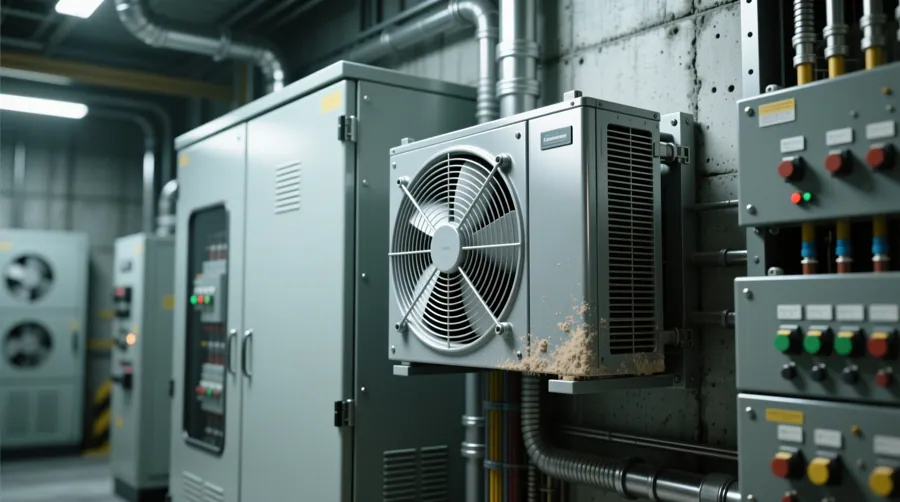
A cabinet cooler keeps electrical cabinets and enclosures at a temperature their contents can survive, in situations where a simple fan cannot do the job. Herambh Coolingz manufactures cabinet coolers for Indian industry from Aurangabad, Maharashtra, alongside its panel air conditioner and chiller ranges.
As cabinets fill with drives, controllers and power supplies, the heat they generate rises while the space available to lose it does not. A cabinet cooler closes that gap and protects the equipment inside.
The Problem Inside a Cabinet
Modern control cabinets hold more electronics than older ones of the same size, and each item adds heat. In a sealed cabinet that heat has nowhere to go, so the internal temperature climbs until components run outside their rated range.
The result is reduced reliability and, in time, failures that are hard to diagnose because the equipment only misbehaves when the cabinet is warm.
Cooling Options for Cabinets
A fan and filter unit brings filtered outside air through the cabinet, which works when the outside air is cool and reasonably clean. A refrigerated cabinet cooler removes heat without opening the cabinet to the surrounding air, so it works in hot, dusty or humid plants.
The right option depends on the ambient conditions, the heat load and how sensitive the contents are to dust and moisture.
How a Cabinet Cooler Works
The cooler uses a refrigeration circuit to move heat from the air inside the cabinet to the air outside. A thermostat controls the compressor so the internal temperature is held at the set point, and condensate from the evaporator is drained safely away.
Because the internal air is never mixed with the plant air, the cabinet stays clean and dry while it is being cooled, which is the key advantage over simple ventilation.
Where Cabinet Coolers Are Used
Cabinet coolers are fitted to machine control panels, drive cabinets, analyser and instrument enclosures, and outdoor kiosks. They are common in foundries, machining shops, cement plants and chemical units where the ambient air would otherwise coat or corrode the internal electronics.
Anywhere the cabinet is sealed to keep contamination out, a cabinet cooler allows it to stay sealed and still run cool.
Sizing a Cabinet Cooler
Selection is based on the heat generated inside the cabinet, the ambient temperature it faces, the required internal temperature and the cabinet surface area that sheds some heat passively. The sum of generated and gained heat is the load the cooler must remove.
A sensible margin means the cooler does not run flat out on the hottest day, which lengthens its life and keeps internal temperature stable.
Construction and Mounting
Cabinet coolers are built in sheet steel with a durable finish and are mounted on the side, top or door of the enclosure. Air paths are fully separated, and the external filter can be cleaned without opening the cabinet.
Installation is straightforward, and the unit carries the thermostat and drain arrangements that most installations need.
Maintenance
Maintenance is external: clean the filter and the condenser coil, and check the controls. In dusty plants this matters more and the interval is shorter; in clean conditions the unit can run for long periods with little attention.
Because nothing inside the cabinet requires service, the enclosure can stay sealed for long stretches, which is exactly what protects the electronics it contains.
Cabinet Cooler or Panel Cooler
Cabinet coolers and panel coolers do the same fundamental job. The distinction is usually one of size and mount, with cabinet coolers applied to the larger enclosures that house complete control systems and panel coolers to individual machine panels.
Herambh Coolingz builds both, so the selection can be made on the actual heat load and site conditions rather than on the label attached to the box.
- Cooling for sealed electrical enclosures
- Keeps dust, mist and humidity outside
- Side, top or door mounting
- Washable external filter
- Sized on internal heat generation
| Parameter | Details |
|---|---|
| Function | Cools a sealed cabinet or control enclosure |
| Principle | Vapour compression refrigeration |
| Air paths | Internal and external circuits kept separate |
| Control | Thermostat holds the set temperature |
| Condensate | Drained away safely |
| Service | External filter and condenser cleaning |
Protecting Electronics and the Investment in Them
A cabinet that houses drives, controllers and power supplies represents a significant investment, and its contents are often the most temperature-sensitive equipment on a machine. Cooling that cabinet is a small cost compared with the production lost when it fails.
Keeping the enclosure sealed while cooling it also protects the electronics from the dust and moisture that shorten the life of every circuit board.
Share your cabinet size, internal heat load and ambient conditions with Herambh Coolingz and we will specify a cabinet cooler for dependable service.