

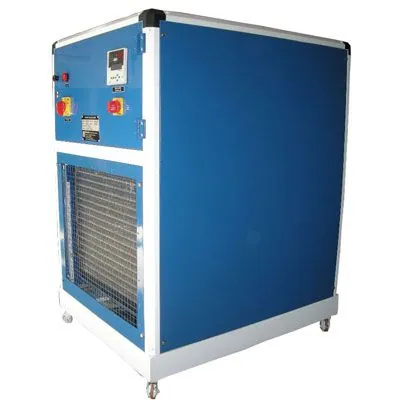
An air cooled chiller rejects its heat to the atmosphere instead of to a cooling tower, so it needs no condenser water circuit at all. That single difference makes it the first choice on sites where water is scarce, expensive or simply not plumbed. Herambh Coolingz manufactures air cooled chillers for Indian industry from Aurangabad, Maharashtra.
Because the condenser is cooled by air, installation is simpler and there is no tower to maintain, no water treatment to supervise and no risk of scale fouling the condenser from poor quality water.
How an Air Cooled Chiller Works
The chiller circulates chilled water through a closed loop, absorbing heat from the process. Inside the machine, refrigerant picks up that heat in the evaporator, is compressed, and gives it up in a condenser coil that a fan blows air across. The heat leaves the machine with the air.
Because the condenser is air cooled, the chiller only needs a supply of moving air, which is available almost everywhere, and it needs no second water circuit to operate.
Why Sites Choose Air Cooling
Water cooled chillers depend on a cooling tower, which consumes water, needs treatment and cleaning, and can freeze or corrode. An air cooled chiller removes all of that from the maintenance and operating budget, at the cost of moving more air and drawing more fan power.
On sites without a tower, or where water scarcity makes one impractical, the air cooled chiller is not just convenient but the only sensible choice.
Typical Applications
Air cooled chillers cool moulds in plastics processing, rolls in printing and coating lines, baths in metal finishing, and lasers, welding and induction equipment. They also provide chilled water for laboratories, packaging lines and process cooling where a tower would be an unnecessary complication.
Where the chiller runs intermittently or the loads are spread out, the simplicity of air cooling is particularly valuable.
Construction and Layout
An air cooled chiller combines compressors, an evaporator, finned condenser coils with fans, an expansion device, a pump and a control panel. Coils are laid out so air passes freely and so they can be cleaned when dust or debris collects.
Large units may use several fans and compressors so that capacity can be staged with the load, and so that a single fault does not stop the whole machine.
Selection and Sizing
Sizing depends on the cooling load, the required chilled water temperature, the ambient air temperature at the installation site and the altitude. Air cooled chillers produce less cooling as ambient temperature rises, so the design point must be the hottest condition the site expects.
Herambh Coolingz sizes air cooled chillers on that worst case, with a margin that keeps the machine from running flat out on the hottest day.
Installation Considerations
Air cooled chillers need unobstructed air flow and space for service, and should be sited so that hot discharge air does not recirculate into the intake, which would reduce capacity and waste energy. A firm, level base and short, well insulated water pipe runs complete a sound installation.
Where several units are installed side by side, they must be spaced so that each draws cool air independently.
Operation and Maintenance
The main service item is the condenser coil. Dust, pollen and plant debris block the fins and reduce capacity, so periodic cleaning keeps the chiller performing. Filters, strainers, refrigerant charge and controls should also be checked on a regular schedule.
Water quality in the chilled water circuit matters too; keeping the circuit clean protects the evaporator and holds heat transfer efficiency.
Advantages and Trade-offs
The advantages are simple installation, no water use, no tower maintenance and freedom from site water problems. The trade-offs are a slightly higher power draw for the fans and a small loss of efficiency compared with a good water cooled installation running on a well maintained tower.
For most industrial users without an existing tower, the air cooled chiller wins on total cost of ownership, because avoiding a whole water circuit removes a permanent maintenance burden.
- No cooling tower or condenser water required
- Suits sites with limited water supply
- Mould, roll, bath and equipment cooling
- Staged fans and compressors for part load
- Simple installation with accessible condenser coils
| Parameter | Details |
|---|---|
| Heat rejection | Directly to atmosphere through finned coils and fans |
| Condenser water | Not required |
| Cooling medium | Chilled water in a closed circuit |
| Sizing point | Hottest expected ambient air temperature |
| Layout | Unobstructed air flow with service space |
| Maintenance | Condenser coil cleaning and routine circuit checks |
Where Air Cooling Makes the Most Sense
Air cooled chillers are the natural choice wherever water is scarce, expensive or simply not available at the installation point. They also suit mobile and outdoor installations, and sites that would rather not take on the upkeep of a cooling tower.
For air cooled chillers sized to your load and local ambient conditions, speak with the Herambh Coolingz team about your process.