

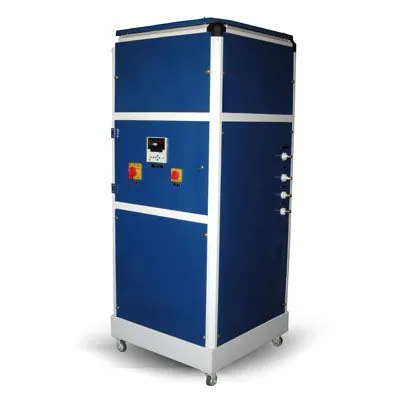
Industrial water chillers supply chilled water to a factory rather than to a single machine. One central chiller can cool many points of use, which is why process plants favour them over a collection of small packaged units. Herambh Coolingz manufactures industrial water chillers in Aurangabad, Maharashtra, and supplies them across India.
The duty of an industrial chiller is to remove heat continuously and predictably, so that whatever depends on chilled water, from a mould to a milk chiller to an anodising tank, sees a stable temperature all shift.
What an Industrial Water Chiller Delivers
The chiller produces a controlled supply of chilled water in a closed circuit. A pump distributes that water to the loads, where it absorbs heat, and returns it to the chiller to be cooled again. The controller holds the supply temperature at the set point so the process never sees a swing.
Because the circuit is closed, the water stays clean and the same volume is reused, which keeps maintenance simple and makes the cooling predictable.
Central Chilling Versus Local Units
A central chiller concentrates the refrigeration plant in one place, where it can be serviced properly and where heat rejection is easier to arrange. It also avoids the noise and clutter of many small units spread across a shop floor.
Local units, by contrast, can be installed close to a single machine and avoid long pipe runs. The right approach depends on the layout of the plant and how the cooling loads are distributed.
Process Duties Served
Plastics processing uses chilled water for mould cooling in injection, blow and extrusion lines. Metal finishing uses it for plating, anodising and pickling baths. Printing uses chilled rolls to set inks, and food processing depends on chilled water for washing and for keeping products cold.
Other duties include cooling welding and induction equipment, instrument air aftercoolers, and the jackets of chemical reactors where an exothermic reaction must be held in check.
Components and Construction
An industrial chiller brings together compressors, a condenser, an evaporator, an expansion device, circulation pumps, a reservoir, piping and a control panel. The arrangement is designed so that each major item can be reached for service without dismantling the machine.
Safety devices include high and low pressure cut-outs, over-current protection, flow interlocks and low temperature protection, so the unit shuts down safely if a load or its own circuit behaves unexpectedly.
Air Cooled and Water Cooled Industrial Chillers
Air cooled industrial chillers reject heat to the atmosphere and need no cooling tower, which simplifies installation and suits plants without a water circuit. Water cooled units reject heat to tower water and are compact and quiet, with efficient rejection where a tower is available.
The choice usually follows from the availability of water, the space available for the condenser and the noise and heat that can be tolerated near the plant.
Sizing the Chiller Plant
Sizing is based on the total cooling load, the chilled water supply and return temperatures, the flow required and the condenser conditions. Loads that peak at different times are combined on a coincident basis rather than simply added, which avoids an oversized plant.
Herambh Coolingz matches capacity, flow and controls to the process, including provision for future loads where the plant expects to expand.
Distribution and Controls
Chilled water is distributed through insulated pipework with balancing valves so each point of use receives its share. Differential pressure or flow control can vary pump output as loads change, saving energy when the plant is not at full demand.
Controls can include temperature alarms, pump interlocks and, on larger plants, staged compressors that bring capacity on and off to match the load efficiently.
Operation and Maintenance
Regular service covers condenser cleaning, refrigerant charge checks, strainer and filter cleaning and control verification. Keeping condensers and heat transfer surfaces clean is what preserves both capacity and efficiency over the years.
Recording supply and return temperatures and pressures in normal operation makes it easy to notice a drift early, so a small service task replaces a large one later.
- Central chilled water for multiple machines
- Mould, bath and roll cooling duties
- Air cooled and water cooled options
- Distribution with balancing and flow control
- Staged capacity to match varying plant load
| Parameter | Details |
|---|---|
| Cooling medium | Chilled water in a closed circuit |
| Condenser | Air cooled or water cooled, as site allows |
| Distribution | Insulated pipework with balancing valves |
| Control | Supply temperature held at set point |
| Safety | Pressure, current, flow and low-temperature cut-outs |
| Capacity | Matched to coincident plant cooling load |
Share your plant cooling load and distribution layout with Herambh Coolingz and we will specify an industrial water chiller to match.