

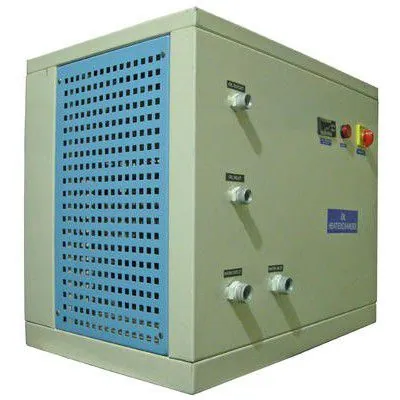
An industrial heat exchanger is a heavy duty unit built to move heat between process streams under the pressures, temperatures and fouling conditions a plant actually sees. Herambh Coolingz fabricates industrial heat exchangers for chemical, food, power and general process duties in India.
Where a light commercial exchanger is designed for clean fluids and modest conditions, an industrial exchanger must be robust enough for continuous service, easy enough to clean when fouling builds up, and safe under the pressures involved.
What Sets an Industrial Heat Exchanger Apart
Industrial service brings high temperatures, high pressures, aggressive fluids and unavoidable fouling. The exchanger must still transfer heat efficiently, be cleanable, and hold its integrity for years. Design margins, material choice and construction detail all follow from those demands.
Serviceability is part of the engineering, because an exchanger that cannot be cleaned will lose capacity no matter how well it was designed.
Common Industrial Configurations
Shell and tube exchangers dominate heavy duty because they tolerate high pressure and temperature and can be cleaned on the tube side and, with a removable bundle, on the shell side too. Plate exchangers suit clean fluids and tight spaces, and finned tube units handle gas to liquid duties such as flue gas cooling.
The configuration follows from the fluids, their states, the fouling they cause and how often cleaning will be possible.
Process Duties Served
Chemical plants use exchangers for reaction heating and cooling, distillation condensers and reboilers, and solvent recovery. Food and dairy lines require hygienic exchangers that can be cleaned thoroughly between products. Power and process plants recover heat from flue gas, condensate and cooling water streams.
Metallurgical and surface treatment plants use them to cool quench water and pickling baths, and many utilities rely on exchangers for lube oil and jacket water cooling.
Materials and Fabrication
Shells, tubes, tube sheets and heads are fabricated in materials chosen for both fluids, with stainless steel common where corrosion or hygiene matters and carbon steel adequate for many utility streams. Higher alloys and non-metallic linings serve the most aggressive duties.
Welding, jointing and pressure testing follow procedures suited to the service, so that the finished exchanger holds both pressure and separation between the two streams.
Thermal and Hydraulic Design
Design balances heat transfer area against allowable pressure drop, because a very efficient exchanger that costs too much in pumping is a poor choice. Flow arrangement, baffling and tube pitch are selected to reach the target duty within the pressure drop the plant can accept.
Fouling allowance is built in, with additional surface and cleaning access so the exchanger keeps performing between maintenance stops rather than needing constant attention.
Selection Data Required
Specifying an exchanger needs the flow rate, inlet and outlet temperatures, pressure and phase of both streams, along with the allowable pressure drops and any fouling tendency. From those, the type, surface area and materials can be settled.
Herambh Coolingz reviews that data and proposes an exchanger arrangement that fits the duty and the site pipework rather than a fixed catalogue model.
Installation and Maintenance
Good installation provides service access, proper supports and piping that does not load the exchanger body. Vents and drains are positioned so that air can be removed and the unit emptied when required.
Maintenance covers tube and shell cleaning, gasket renewal and periodic pressure testing. Monitoring pressure drop and outlet temperatures in normal service shows when cleaning is due, well before capacity loss becomes a problem.
Long Term Reliability
An industrial exchanger earns its place by running for years with predictable servicing. That comes from sensible margins, correct materials and attention to detail at joints and connections, not from squeezing the last percentage of heat transfer out of the design.
When the exchanger is part of a larger system, such as a chiller or a water heater, its reliability sets the reliability of the whole machine, which is why the fabrication detail matters as much as the thermal calculation.
- Shell and tube, plate and finned tube types
- Built for high pressure, temperature and fouling
- Chemical, food, power and utility duties
- Materials selected for both process streams
- Cleaning access designed in from the start
| Parameter | Details |
|---|---|
| Configuration | Shell and tube, plate, or finned tube |
| Materials | Carbon steel, stainless steel, higher alloys |
| Design data | Flows, temperatures, pressures, allowable pressure drop |
| Fouling | Allowance built into surface area and cleaning access |
| Fabrication | Welded and pressure tested to suit the service |
| Maintenance | Tube and shell cleaning, gasket renewal, pressure testing |
Send the flows, temperatures and pressures for your process duty, and Herambh Coolingz will propose an industrial heat exchanger to suit.